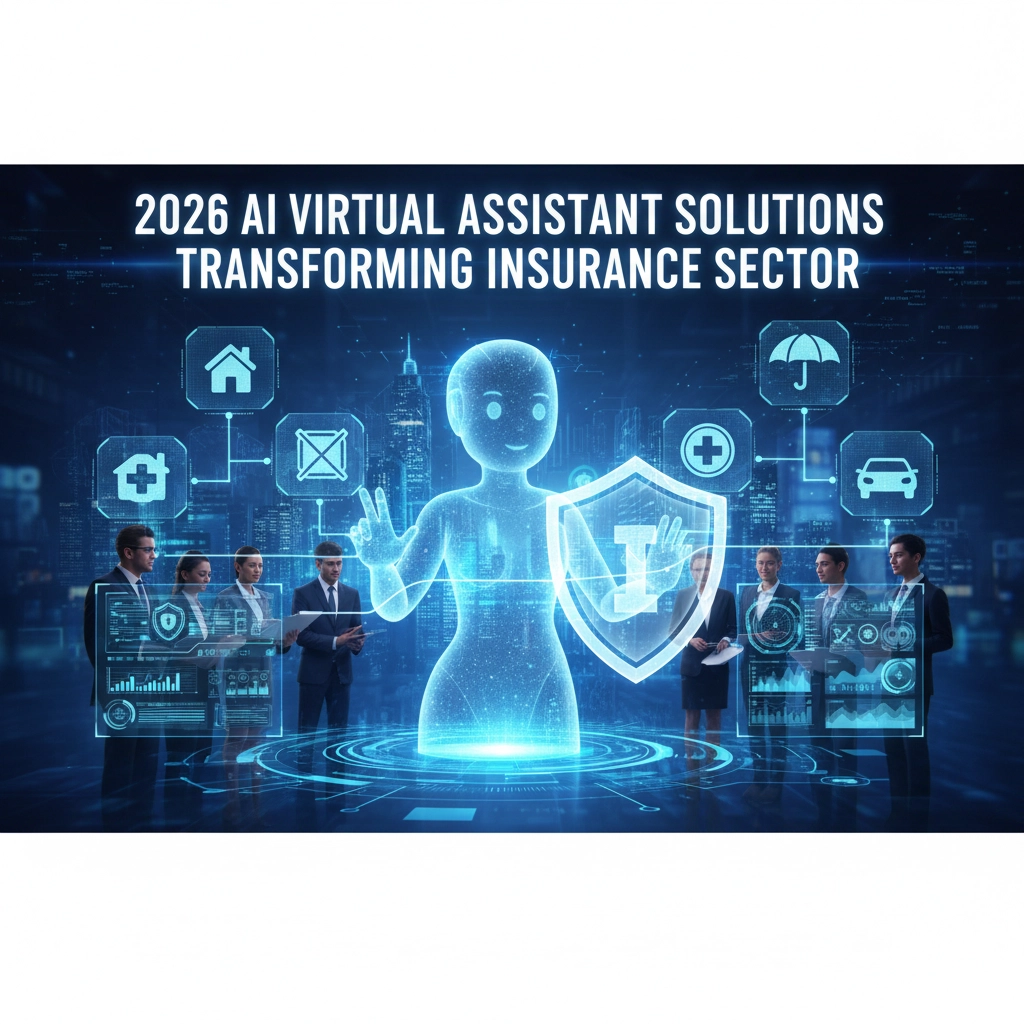
The insurance industry is experiencing its most significant technological transformation in decades. As we move through 2026, AI virtual assistant solutions are no longer experimental: they're becoming the competitive backbone of forward-thinking US insurance agencies. From automating complex claims processing to delivering 24/7 customer support, these intelligent systems are reshaping how insurance companies operate, compete, and serve their clients.
Revolutionary Applications Driving Industry Change
Intelligent Claims Processing and Virtual Claims Assistants
The most impactful transformation is happening in claims processing. Virtual Claims Assistants (VCAs) are revolutionizing backend operations by automatically reviewing incoming communications, accurately categorizing correspondence, and filing documents under correct claim files. These AI systems can summarize lengthy documents in seconds, highlight areas requiring immediate follow-up, and prioritize adjuster workloads by scanning backlogs to identify critical tasks.
For US insurance agencies, this means each claims adjuster essentially has their own AI assistant handling administrative burden. Adjusters can now focus on decision-making and delivering the personalized, empathetic service that customers value most during stressful claim situations.

24/7 Customer Service and Support Automation
AI chatbots and virtual assistants now provide round-the-clock support, fundamentally changing how insurers handle routine customer interactions. These systems guide customers through policy queries, claims submissions, and renewals with instant availability. The result? Reduced response times, improved customer satisfaction, and human agents freed up for complex, high-value interactions.
Modern insurance virtual assistants can:
- Process policy changes in real-time
- Provide instant quotes for new coverage
- Guide customers through claims filing
- Answer complex coverage questions using natural language
- Escalate to human agents when needed
Advanced Fraud Detection and Prevention
AI virtual assistants analyze claims for suspicious patterns and inconsistencies, providing a critical protective layer for insurance agencies. By learning from historical fraud cases and identifying anomalies in real-time, these systems protect honest policyholders and help maintain healthy loss ratios.
According to industry analysis, property and casualty insurers could save up to $160 billion by 2032 through AI-driven, real-time fraud analytics: a massive opportunity for US agencies looking to improve their bottom line while serving customers better.
Step-by-Step Automation Implementation
Phase 1: Customer Interaction Automation
Start with customer-facing chatbots that handle routine inquiries, policy information requests, and basic claims reporting. This immediately improves response times and frees up human agents.
Phase 2: Document Processing and Management
Implement AI systems that can read, categorize, and process incoming documents: from claim forms to medical records. This dramatically speeds up initial processing times.
Phase 3: Intelligent Claims Routing and Prioritization
Deploy virtual assistants that can analyze claim complexity, urgency, and potential issues, then route to the most appropriate adjuster or specialist.
Phase 4: Predictive Analytics and Risk Assessment
Integrate AI systems that analyze diverse data sources: health records, driving history, property conditions: to evaluate risks with higher precision than traditional methods.

Measurable Impact on Insurance Operations
Operational Efficiency Gains
Insurance agencies implementing AI virtual assistants report significant improvements in processing speed. Claims that previously took days for initial review now receive preliminary assessment within hours. Document processing that required manual review and filing is now automated, reducing human error and accelerating overall case resolution.
Cost Reduction and Resource Optimization
Automation eliminates repetitive tasks and streamlines resource-intensive verification processes. Staff can focus on strategic decision-making, complex case analysis, and customer relationship building: activities that directly impact agency growth and customer retention.
Enhanced Accuracy and Quality Control
Virtual assistants provide consistent rule application and continuous analysis, improving overall quality control. Unlike human processing, AI systems don't have off days or inconsistent interpretations: they apply the same standards 24/7.
Customer Satisfaction and Retention
Personalized experiences and faster service delivery significantly improve customer satisfaction scores. Insurance customers increasingly expect immediate responses and self-service options, which AI virtual assistants deliver effectively.
Cutting-Edge Tools Shaping Insurance in 2026
Conversational AI Platforms
Modern insurance virtual assistants use advanced natural language processing to understand complex customer inquiries and provide detailed, contextual responses. These platforms integrate seamlessly with existing insurance management systems.
Intelligent Document Processing (IDP)
AI-powered document processing tools can extract relevant information from forms, photos, medical records, and legal documents with near-perfect accuracy, dramatically speeding up claims and underwriting processes.
Predictive Analytics Engines
These tools analyze historical data patterns to predict claim likelihood, fraud probability, and customer lifetime value, enabling more informed underwriting and pricing decisions.

Strategic Implementation for US Insurance Agencies
Building AI-Ready Infrastructure
Successful implementation starts with robust data infrastructure. Insurance agencies need clean, accessible data systems that AI tools can analyze effectively. This often requires modernizing legacy systems and establishing clear data governance protocols.
Hybrid AI-Human Models
The most successful implementations combine AI efficiency with human expertise. Virtual assistants handle routine tasks and data analysis while human agents focus on complex decisions requiring empathy, negotiation, and relationship building.
Staff Training and Change Management
Successful AI adoption requires comprehensive staff training. Employees need to understand how to work alongside virtual assistants, interpret AI-generated insights, and focus on high-value activities that require human judgment.
Compliance and Security Considerations
Insurance agencies must ensure AI systems comply with state and federal regulations while maintaining strict data security standards. This includes implementing proper audit trails and maintaining transparency in AI decision-making processes.
ROI and Performance Metrics
Insurance agencies implementing comprehensive AI virtual assistant solutions report impressive returns on investment. Key performance improvements include:
- 40-60% reduction in initial claims processing time
- 35-50% improvement in customer response times
- 25-40% reduction in administrative costs
- 20-30% improvement in fraud detection accuracy
- 15-25% increase in customer satisfaction scores
These metrics demonstrate that AI virtual assistant investment pays for itself while improving customer experience and operational efficiency.

Future-Proofing Your Insurance Agency
As we advance through 2026, the insurance landscape will continue evolving rapidly. Agencies that invest in AI virtual assistant technology now position themselves for long-term competitive advantage. The technology is moving from experimental to essential: agencies that delay implementation risk falling behind competitors who embrace these powerful automation tools.
The key is starting with pilot programs in specific areas: customer service, claims processing, or fraud detection: then expanding based on proven results and staff comfort with the technology.
Transform Your Insurance Agency with Expert AI Implementation
Ready to revolutionize your insurance operations with cutting-edge AI virtual assistant solutions? Virtual Nexgen Solutions specializes in helping US insurance agencies implement powerful automation technologies that deliver immediate results and long-term competitive advantage.
Our team understands the unique challenges facing insurance agencies in 2026: from regulatory compliance to customer experience demands. We provide customized AI virtual assistant solutions that integrate seamlessly with your existing systems while delivering measurable improvements in efficiency, accuracy, and customer satisfaction.
Don't let your competition gain the advantage of AI automation. Book a free 30-minute consultation to discover how Virtual Nexgen Solutions can transform your insurance operations and position your agency for success in the AI-driven insurance landscape.
Visit virtualnexgen.com to learn more about our specialized insurance automation solutions and see real case studies from agencies already benefiting from AI virtual assistant technology.
About Virtual Nexgen Solutions: We're a leading provider of AI and Virtual Assistant services, specializing in helping US businesses harness the power of automation to improve efficiency, reduce costs, and enhance customer experiences. Our insurance-focused solutions are designed specifically for the unique needs and regulatory requirements of the US insurance industry.