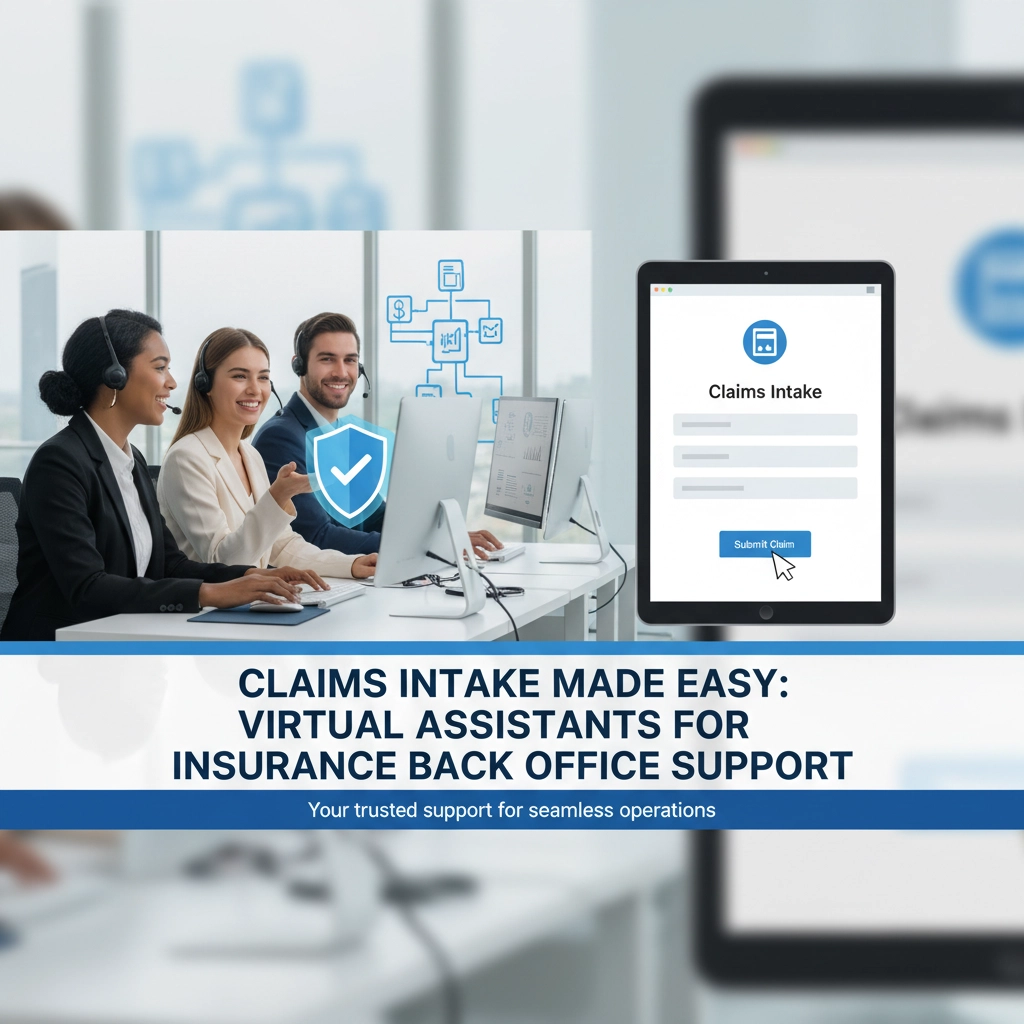
The insurance industry processes over 40 million claims annually, yet most agencies still rely on manual, paper-heavy workflows that drain resources and delay customer service. Insurance claims intake automation has emerged as a game-changer, with virtual assistants (VAs) transforming how agencies handle everything from initial client contact to final claim submission.
For insurance agencies drowning in administrative tasks, virtual assistants offer a lifeline. They streamline insurance back office services, reduce processing times by up to 70%, and free up licensed agents to focus on high-value client relationships and business growth.
The Claims Intake Challenge: Why Traditional Methods Fall Short
Claims intake traditionally involves a complex web of documentation, client communication, data entry, and carrier coordination. The average insurance claim requires 15-20 touch points before resolution, with each step creating potential bottlenecks.
Common pain points include:
- Document chaos: Missing paperwork, incomplete forms, and scattered communications
- Manual data entry errors that delay processing and frustrate clients
- Time-consuming follow-ups with clients, adjusters, and carriers
- Compliance tracking across multiple states and carriers
- Resource allocation issues where licensed agents spend 60% of their time on administrative tasks

How Virtual Assistants Revolutionize Insurance Claims Intake
AI automation experts for businesses understand that successful claims intake automation requires both technology and human expertise. Virtual assistants bridge this gap by combining systematic workflows with personalized client service.
Step 1: Initial Claim Documentation and Client Contact
Virtual assistants take immediate control of new claims by establishing contact with clients within 24 hours. They gather essential information including:
- Policy details and coverage verification
- Incident reports and supporting documentation
- Contact information for all involved parties
- Photos, repair estimates, and medical records (where applicable)
This proactive approach ensures nothing falls through the cracks while providing clients with immediate reassurance that their claim is being handled professionally.
Step 2: Form Completion and Carrier Submission
Rather than waiting for clients to navigate complex claim forms, VAs complete all necessary paperwork using information gathered during initial contact. They ensure forms are accurate, complete, and submitted to the correct carriers within required timeframes.
Virtual assistants are trained on carrier-specific requirements, reducing the back-and-forth that typically delays claim processing. This expertise translates to 40% faster submission times compared to traditional methods.
Step 3: Ongoing Communication and Status Management
VAs maintain continuous communication loops with all stakeholders throughout the claims process. They provide regular updates to clients, follow up on pending documentation from carriers, and escalate issues requiring agent intervention.
This systematic approach keeps claims moving forward while ensuring clients feel supported and informed throughout what can be a stressful process.
Core Virtual Assistant Tasks in Insurance Back Office Services
Document Management and Organization
Virtual assistants excel at transforming document chaos into organized, searchable systems. They scan, categorize, and upload all claim-related documents into agency management systems (AMS), ensuring instant access when needed.
Key document management tasks include:
- Creating digital claim files with consistent naming conventions
- Organizing supporting documentation by claim type and carrier requirements
- Maintaining compliance documentation for regulatory audits
- Setting up automated alerts for missing or expired documents

Data Entry and CRM Management
Accurate data entry is crucial for successful claims processing. VAs handle all data input tasks while maintaining strict quality control standards. They update client records, input claim details into management systems, and ensure information consistency across all platforms.
This attention to detail reduces errors that can delay claims or create compliance issues down the line.
Carrier Communication and Follow-up
Virtual assistants manage ongoing communication with insurance carriers, tracking claim status and following up on pending items. They understand carrier-specific communication preferences and requirements, ensuring nothing gets lost in translation.
Regular carrier communication includes:
- Status update requests and documentation
- Clarification on coverage questions or claim denials
- Coordination of inspections and appraisals
- Tracking settlement timelines and payment processing
Industry-Specific Expertise That Drives Results
Insurance back office services require specialized knowledge that goes beyond general administrative support. Virtual assistants working in insurance are trained on:
Regulatory Compliance and Industry Standards
VAs understand state insurance regulations, HIPAA requirements (for health-related claims), and carrier-specific compliance standards. This expertise ensures all claim handling meets regulatory requirements while protecting agencies from compliance risks.
Technology Integration and Software Proficiency
Modern insurance agencies rely on sophisticated technology platforms. Virtual assistants are trained on industry-standard software including:
- Applied Systems (Epic, TAM, ImageRight)
- AMS360 and related Vertafore products
- HawkSoft agency management systems
- QQ Catalyst and Duck Creek platforms
- Carrier-specific portals and submission systems
This technical proficiency means VAs integrate seamlessly into existing workflows without requiring extensive training or software modifications.

Specialized Claims Knowledge
Different claim types require specific expertise. Virtual assistants are trained on:
- Property claims: Understanding coverage types, depreciation schedules, and repair processes
- Auto claims: Coordinating with body shops, rental car companies, and medical providers
- Workers' compensation: Managing medical documentation, return-to-work programs, and regulatory reporting
- Commercial claims: Handling complex business interruption, liability, and property claims
Measurable Benefits: ROI of Virtual Assistant Implementation
Agencies implementing virtual assistant support report significant operational improvements:
Cost Reduction and Efficiency Gains
- 50-60% reduction in administrative costs compared to hiring additional full-time staff
- 70% faster initial claim processing from intake to carrier submission
- 40% increase in claims handled per agent without additional overhead
- 85% improvement in client satisfaction scores related to communication and responsiveness
Revenue Growth Through Better Resource Allocation
When licensed agents focus on sales and client relationship management instead of administrative tasks, agencies see:
- 25-30% increase in new business acquisition
- Higher retention rates due to improved client service
- Expanded capacity to handle larger commercial accounts
- Improved carrier relationships through consistent, professional claim handling
Technology Integration: AI and Automation Amplify VA Impact
The most effective insurance claims intake automation combines virtual assistant expertise with AI-powered tools. This hybrid approach leverages:
Automated Document Processing
AI tools scan and extract key information from insurance documents, while VAs review and verify accuracy. This combination provides speed and accuracy that neither technology nor human workers can achieve alone.
Intelligent Workflow Management
Automated workflow systems route claims to appropriate VAs based on claim type, complexity, and workload distribution. This ensures optimal resource allocation and consistent service quality.
Predictive Analytics for Proactive Management
AI systems identify potential claim complications early in the process, allowing VAs to take proactive steps to prevent delays or denials.

Implementation Strategy: Getting Started with Virtual Assistant Support
Assessment and Planning
Successful VA implementation begins with analyzing current claim handling processes to identify bottlenecks and inefficiencies. Agencies should map existing workflows and establish baseline metrics for processing times, error rates, and client satisfaction.
Training and Integration
Virtual assistants require comprehensive training on agency-specific procedures, software platforms, and client service standards. The most effective programs include ongoing training updates to ensure VAs stay current with industry changes and technology updates.
Performance Monitoring and Optimization
Regular performance reviews ensure VA support continues meeting agency needs. Key metrics include claim processing speed, accuracy rates, client feedback scores, and carrier relationship quality.
Transform Your Insurance Agency with Professional Virtual Assistant Support
Insurance claims intake automation isn't just about efficiency: it's about transforming your agency into a client-focused, growth-oriented business. Virtual assistants handle the administrative complexity that bogs down traditional agencies while ensuring every client receives professional, responsive service.
Virtual Nexgen Solutions specializes in providing trained insurance virtual assistants who understand your industry's unique challenges and requirements. Our AI automation experts for businesses work with insurance agencies to implement comprehensive back office support that drives measurable results.
Our virtual assistants are trained on leading insurance platforms, understand regulatory requirements, and integrate seamlessly into your existing workflows. Whether you're handling property claims, auto insurance, workers' compensation, or commercial lines, our team provides the specialized support you need to scale your operations effectively.
Ready to transform your claims intake process and free up your team for high-value activities? Schedule a consultation with Virtual Nexgen Solutions to discover how our insurance virtual assistant services can streamline your operations and accelerate your agency's growth.
Don't let administrative bottlenecks limit your agency's potential. Contact Virtual Nexgen Solutions today and discover how professional virtual assistant support can transform your insurance back office operations.