Choosing between virtual assistants and AI automation feels like navigating a maze – especially when your business growth depends on making the right call. You're not alone in this dilemma. Over 70% of small and medium businesses are actively weighing these options, trying to figure out which solution delivers better ROI, reliability, and results.
The truth? There's no one-size-fits-all answer. But there is a clear framework to help you decide what works best for your specific business needs, budget, and growth trajectory.
Understanding Your Options: The Three Paths Forward
Before diving into comparisons, let's clarify what we're actually comparing. You have three distinct paths:
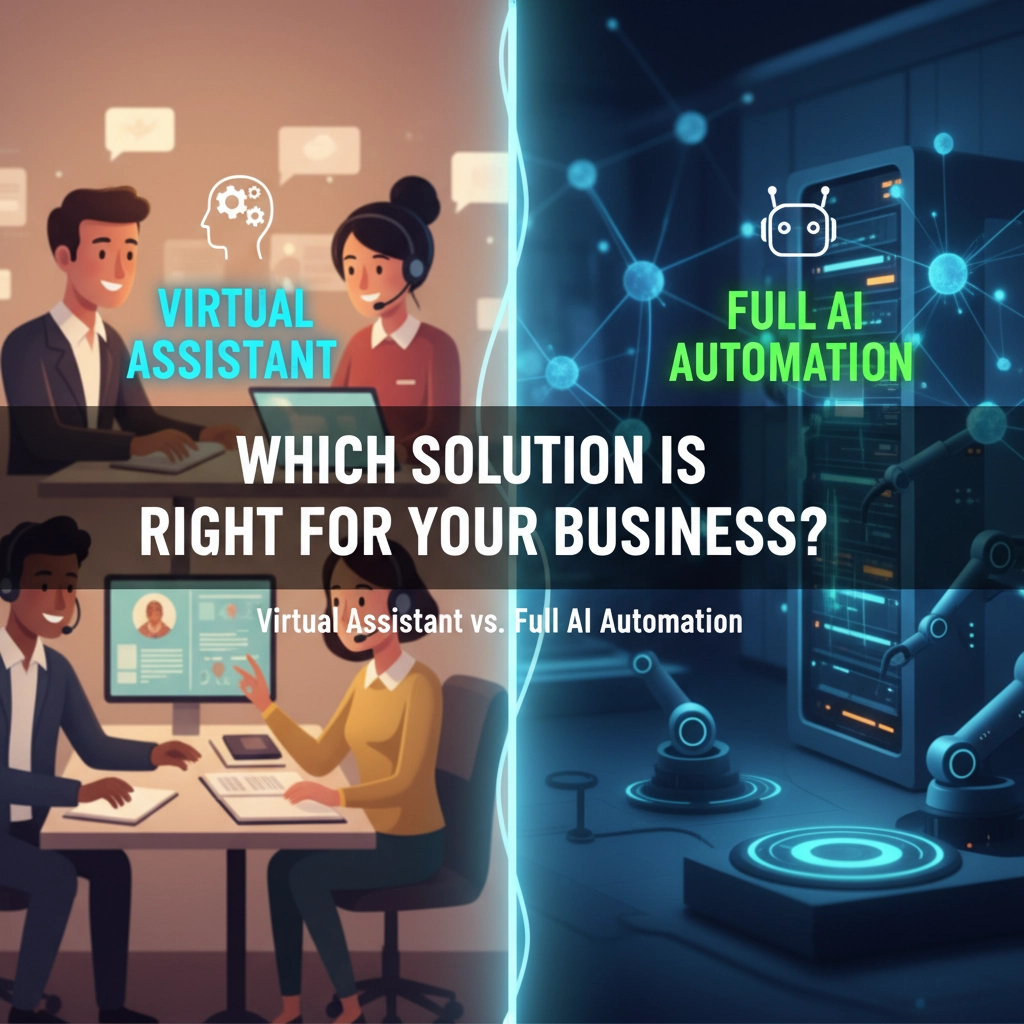
Dedicated Virtual Assistants – Real people (often offshore) who work remotely as part of your team
Full AI Automation – Software systems that handle tasks without human intervention
Hybrid Solutions – A combination approach using both human VAs and AI tools strategically
Each serves different business needs, and understanding these differences is crucial for making an informed decision.
The Case for Virtual Assistants: When Human Intelligence Wins
Virtual assistants bring something AI can't replicate – genuine human judgment and emotional intelligence. They understand context, read between the lines, and adapt to unique situations that would stump even the most sophisticated AI system.
Core Strengths of Virtual Assistants
Relationship Management Excellence: VAs excel at building and maintaining client relationships. They remember personal details, understand communication preferences, and can navigate sensitive conversations with finesse. This is particularly valuable for industries like real estate, insurance, and professional services where relationships drive business.
Complex Problem Solving: When faced with unusual scenarios or exceptions, human virtual assistants think creatively and find solutions. They can connect dots across different systems, make judgment calls, and handle ambiguity – skills that AI automation simply can't match.
Adaptability and Learning: A good VA learns your business deeply over time. They anticipate needs, suggest improvements, and become genuinely invested in your success. This creates compounding value that grows stronger with time.

The Reality Check: Virtual Assistant Limitations
Despite their strengths, VAs come with inherent constraints. They work within specific hours (usually 8-10 hours daily), have capacity limits, and require management overhead. Scaling means hiring more people, which increases complexity and costs.
The financial model also differs significantly. You're paying for time, not just output. During slow periods, you're still covering salary costs. And quality can vary – you're dependent on individual performance, motivation, and retention.
Full AI Automation: The Speed and Scale Advantage
AI automation operates on a completely different paradigm. Instead of hiring people, you're deploying intelligent systems that work 24/7 without breaks, sick days, or vacation time.
Where AI Automation Dominates
Volume and Speed: AI systems can process hundreds or thousands of tasks daily. They respond instantly, handle multiple requests simultaneously, and never get overwhelmed. For high-volume, repetitive tasks like lead qualification, appointment scheduling, or data entry, AI automation is unmatched.
Consistency and Accuracy: Unlike humans, AI doesn't have off days. Every task is executed with the same level of precision and attention to detail. This is particularly valuable for processes requiring strict compliance or standardization.
Cost Efficiency at Scale: The economics of AI automation become compelling quickly. After initial setup costs, the marginal cost per task approaches zero. Process 100 invoices or 10,000 – the cost remains essentially the same.
Understanding AI Limitations
AI automation has clear boundaries. It struggles with nuance, can't handle true exceptions well, and lacks the emotional intelligence needed for sensitive interactions. It's reactive rather than proactive and operates within predefined rules and workflows.
Complex decision-making that requires weighing multiple variables, understanding company politics, or making judgment calls about customer satisfaction still requires human intervention.

The Hybrid Approach: Best of Both Worlds
Smart businesses increasingly recognize that the "versus" in "Virtual Assistant vs. AI Automation" is a false choice. The most effective approach often combines both strategically.
How Hybrid Solutions Work
In a hybrid model, AI automation handles the routine, high-volume tasks while virtual assistants focus on complex, relationship-driven work. For example:
- AI manages initial lead capture and qualification
- VAs conduct discovery calls and relationship building
- AI handles appointment scheduling and reminders
- VAs manage complex client communications and problem resolution
This division of labor maximizes efficiency while maintaining the human touch where it matters most.
Decision Framework: Choosing Your Path
Choose Virtual Assistants When:
Your tasks require emotional intelligence: Customer service, sales conversations, and relationship management benefit from human empathy and understanding.
You need creative problem-solving: Complex projects, strategic planning, and exception handling require human creativity and judgment.
Quality over quantity matters: When the stakes are high and perfect execution is more important than speed or volume.
You prefer personal relationships: Some business owners value having a dedicated person who knows their business intimately.
Choose AI Automation When:
You have high-volume, repetitive tasks: Data entry, lead research, appointment scheduling, and email management are perfect for automation.
Speed and availability are critical: 24/7 response times and instant processing are business requirements.
Scalability is a priority: You need to handle growing task volume without proportionally increasing costs.
Budget efficiency matters: You want to minimize ongoing operational costs while maintaining quality output.
Choose Hybrid Solutions When:
You want to optimize for both efficiency and quality: Most growing businesses fall into this category.
Your workflows include both routine and complex tasks: You handle everything from simple data processing to strategic relationship management.
You're scaling rapidly: You need the efficiency of automation but can't sacrifice the quality that human judgment provides.

Making the Financial Case
The ROI calculation differs significantly between these approaches:
Virtual Assistant ROI: Calculate the value of tasks completed multiplied by what those tasks would cost if done internally, minus the VA's total compensation (salary, benefits, management time).
AI Automation ROI: Track time saved per task, multiply by your team's hourly rate, then subtract implementation and ongoing software costs.
Hybrid ROI: More complex but often highest – you get the efficiency gains of automation plus the quality premiums of human judgment where it matters most.
Industry-Specific Considerations
Different industries lean toward different solutions:
Real Estate: Benefits from hybrid approaches – AI for lead capture and nurturing, VAs for client relationships and transaction management. Virtual Nexgen's real estate solutions exemplify this approach.
Professional Services: Often prefer dedicated VAs for client relationship management and complex project coordination.
E-commerce: Gravitates toward AI automation for order processing, customer service, and inventory management.
Healthcare: Requires hybrid solutions due to compliance requirements – AI for scheduling and basic inquiries, humans for patient care coordination.
Implementation Strategy
Regardless of your choice, successful implementation follows similar principles:
Start Small: Begin with one or two specific use cases rather than trying to automate everything at once.
Measure Everything: Track key metrics from day one – time saved, error rates, customer satisfaction, and cost per task.
Plan for Integration: Ensure your chosen solution integrates well with existing systems and workflows.
Prepare for Change Management: Train your team on new processes and set clear expectations about how the solution will impact their roles.
The Virtual Nexgen Advantage
At Virtual Nexgen Solutions, we understand that this isn't really an either/or decision. That's why we offer flexible solutions that can grow and adapt with your business. Whether you need dedicated virtual assistants, AI automation tools, or a strategic hybrid approach, we help you build the right solution for your specific needs.
Our clients typically start with one approach and evolve their strategy as they grow. A small business might begin with a part-time virtual assistant, add AI automation for routine tasks as volume increases, then scale to a full hybrid solution as they expand.
Your Next Step
The choice between virtual assistants, AI automation, or a hybrid approach ultimately depends on your specific business needs, current workflows, and growth objectives. The key is starting with a clear understanding of your priorities and being willing to adapt as you learn what works best.
Ready to explore what's possible for your business? Let's discuss your specific situation and design a solution that delivers real results. Book a free 30-minute strategy session with our team at Virtual Nexgen Solutions, and let's find the perfect approach for your business growth.
Your next level of productivity and efficiency is just one decision away.