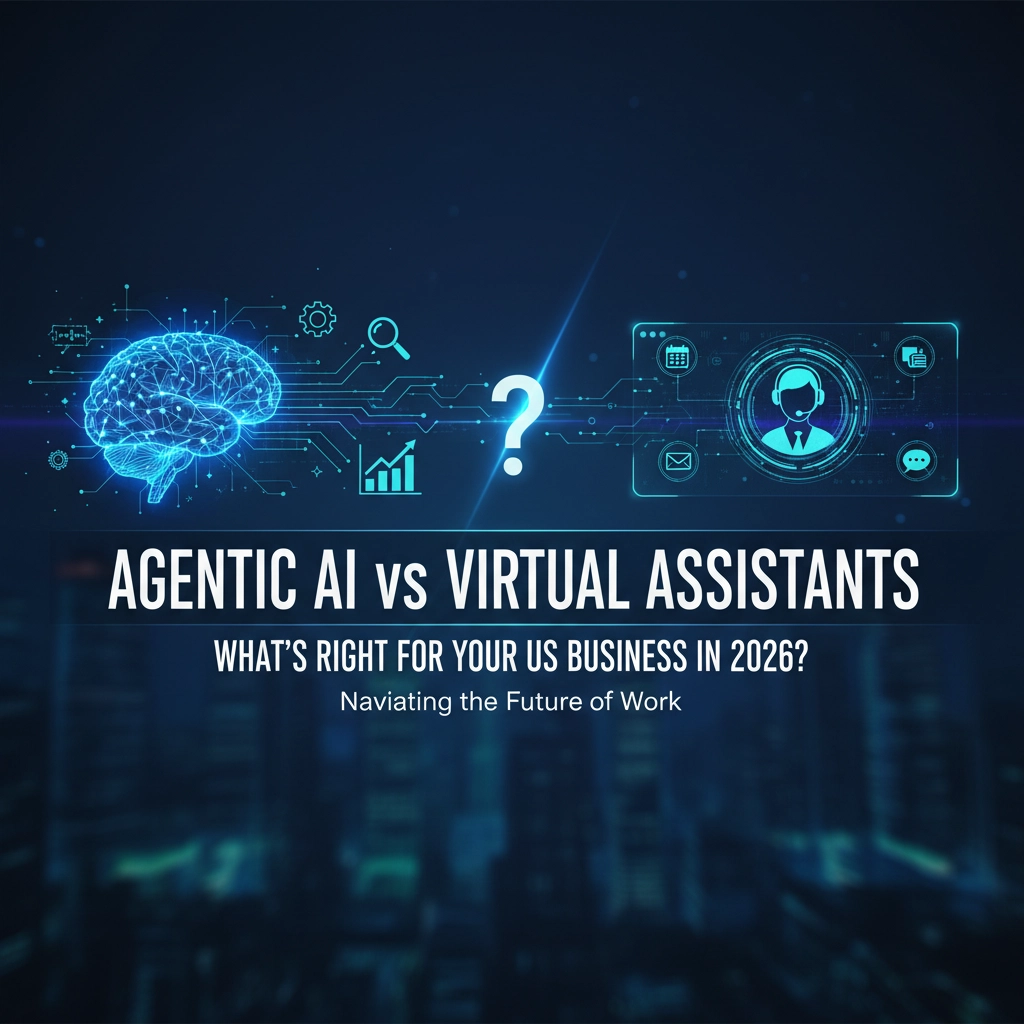
As we step into 2026, US businesses face a critical decision: should they invest in agentic AI systems or stick with traditional virtual assistants? With 99% of enterprise developers exploring AI agents and 44% of IT executives planning major investments in agentic technology, understanding the difference isn't just important: it's essential for staying competitive.
The choice between these two approaches can make or break your digital transformation strategy. Let's dive deep into what sets them apart and help you make the right decision for your business.
Understanding the Core Distinction
The fundamental difference between agentic AI and virtual assistants lies in their operational DNA. Agentic AI responds by taking autonomous action toward predefined goals, while virtual assistants traditionally respond to user requests reactively. Think of it this way: agentic AI is like having a highly capable manager who understands your business goals and works independently to achieve them, while virtual assistants are like skilled coordinators who excel at helping you execute specific tasks.

This distinction becomes crucial when you consider scalability. Agentic AI systems operate through four interconnected components: reasoning, planning, tool orchestration, and memory. These create a feedback loop that enables genuine autonomy: meaning they can adapt, learn, and improve without constant human oversight.
Agentic AI: The Autonomous Powerhouse
Agentic AI systems are revolutionizing how businesses approach automation. These aren't your typical rule-based bots; they're sophisticated systems capable of independent decision-making, multi-step planning, and continuous learning.
Key Capabilities That Drive Results:
Autonomous Decision-Making: These systems analyze complex scenarios and make informed decisions without waiting for human input. A fraud detection agent, for example, can process over 100 million transactions daily, identifying 95% of fraudulent activity while reducing false positives by 75%.
Multi-Step Planning and Execution: Unlike traditional automation, agentic AI can break down complex goals into actionable steps, adapt when circumstances change, and execute entire workflows independently. A Dutch insurance company automated 90% of their automotive claims processing using this approach.
Persistent Memory and Learning: These systems remember past interactions, learn from outcomes, and continuously improve their performance. This isn't just data storage: it's intelligent knowledge accumulation that makes each interaction more effective than the last.
Real-World Impact: The numbers speak for themselves. Organizations implementing agentic AI report 20-60% productivity gains compared to just 5-10% for traditional generative AI. A major bank's virtual agent completed over 1 billion transactions while reducing call-center volume by 17%. Businesses consistently see 30-40% reduction in operational costs through 24/7 operation without fatigue or overtime expenses.
Virtual Assistants: The Human-Centric Solution
While agentic AI excels at autonomous operation, virtual assistants: particularly the empathetic variants emerging in 2026: focus on understanding context, emotion, and human intent. These systems shine in scenarios requiring human connection and nuanced understanding.

Advanced Emotional Intelligence: Modern virtual assistants can assess user engagement levels, emotional states through facial expressions, and even personality traits that develop over time. Some systems demonstrate 85% accuracy in assessing mental health conditions compared to human experts, analyzing both verbal and non-verbal communication in just five minutes.
Multimodal Capabilities: Today's virtual assistants don't just process text: they analyze visual cues, environmental factors, and even voice tonality to provide contextually appropriate responses. They can handle damage assessment after storms, conduct safety inspections, verify vehicles, and monitor compliance by combining enterprise knowledge with real-time visual observation.
Customer-Focused Results: H&M's virtual shopping assistant exemplifies this approach, resolving 70% of customer queries autonomously, boosting conversion rates by 25%, and reducing response times by 3×. These systems consistently reduce response times by 70% while providing 24/7 global availability.
For businesses seeking a Dedicated Virtual Assistant for Businesses, modern virtual assistants offer the perfect blend of efficiency and human-like interaction that customers expect in 2026.
Head-to-Head Comparison: Making the Right Choice

| Dimension | Agentic AI | Virtual Assistants |
|---|---|---|
| Autonomy Level | Proactive; independently sets and pursues goals | Reactive or semi-proactive; primarily responds to requests |
| Decision-Making | Autonomous, adaptive, learns from feedback | User-guided, context-aware, emotionally intelligent |
| Problem-Solving Approach | Complex, multi-step execution; plans and adapts dynamically | Step-by-step user collaboration; understands intent and emotion |
| Learning Capability | Continuous adaptation from outcomes and feedback loops | Pattern recognition with emotional and contextual awareness |
| Productivity Gains | 20–60% improvements | Variable; focused on user satisfaction and engagement |
| Cost Reduction | 30–40% operational cost reduction | Cost reduction through improved response times and staffing efficiency |
| User Interaction | Minimal human involvement required; works independently | Frequent collaboration; understands frustration and adapts approach |
| Best Use Cases | Loan processing, supply chain, fraud detection, compliance | Customer service, healthcare consultation, safety assessment |
| Implementation Complexity | High initial setup, but operates independently afterward | Moderate setup with ongoing optimization for user experience |
Strategic Recommendations for US Businesses in 2026
Choose Agentic AI When Your Business Needs:
Process Transformation: If you're looking to fundamentally change how work gets done rather than just making existing processes slightly faster, agentic AI is your answer. Companies in financial services, supply chain management, and fraud prevention see the most dramatic improvements.
High-Volume Operations: Businesses processing thousands of transactions, applications, or decisions daily benefit enormously from agentic AI's ability to work continuously without breaks, mistakes, or oversight.
Clear Goal Definition: If you can clearly define success metrics and business outcomes, agentic AI can work toward those goals independently, adapting its approach based on real-time feedback and changing conditions.
Choose Virtual Assistants When Your Business Prioritizes:
Customer Experience: For businesses in retail, healthcare, or service industries where customer satisfaction and emotional connection matter, virtual assistants excel at providing personalized, empathetic interactions.
Collaborative Problem-Solving: When tasks require ongoing human-AI collaboration, contextual understanding, or situations where empathy and emotional intelligence are crucial, virtual assistants provide the human touch that customers expect.
Complex Context Analysis: For roles requiring visual assessment, safety monitoring, or compliance verification where understanding nuanced situations is essential, virtual assistants offer the contextual awareness needed.

For businesses looking to implement either solution effectively, working with experienced AI Automation Experts for Businesses becomes crucial. The implementation strategy, system integration, and ongoing optimization require specialized expertise to maximize ROI.
The Winning Strategy: A Hybrid Approach
The most successful US businesses in 2026 won't choose between agentic AI and virtual assistants: they'll strategically deploy both. Here's how smart companies are approaching this:
Backend Operations: Deploy agentic AI for supply chain optimization, fraud detection, loan processing, and other data-intensive processes that benefit from autonomous operation.
Customer-Facing Interactions: Implement empathetic virtual assistants for customer service, sales support, and any interaction requiring emotional intelligence and human connection.
Seamless Integration: The magic happens when these systems work together. Agentic AI can handle the heavy lifting of data analysis and process automation, while virtual assistants manage customer communications and relationship building.
This hybrid approach maximizes efficiency through autonomous backend operations while ensuring customer interactions remain personalized and emotionally intelligent. Companies implementing this strategy report the highest satisfaction rates and most significant competitive advantages.
Ready to Transform Your Business Operations?
Whether you're leaning toward agentic AI, virtual assistants, or a hybrid approach, the key to success lies in proper implementation and ongoing optimization. At Virtual Nexgen Solutions, we specialize in helping US businesses navigate these complex decisions and implement solutions that drive real results.
Our team of experts can assess your specific business needs, recommend the right mix of AI technologies, and provide ongoing support to ensure your investment pays off. From Marketing Virtual Assistants to Real Estate Virtual Assistant services, we've helped businesses across industries achieve their automation goals.
Don't let the competition get ahead while you're still deciding. Book a free consultation today to discover which AI solution will give your business the edge it needs in 2026. Schedule your 30-minute strategy session now and let's build your AI-powered future together.
The question isn't whether AI will transform your business: it's whether you'll lead the transformation or follow behind. Make 2026 the year your business takes the lead.