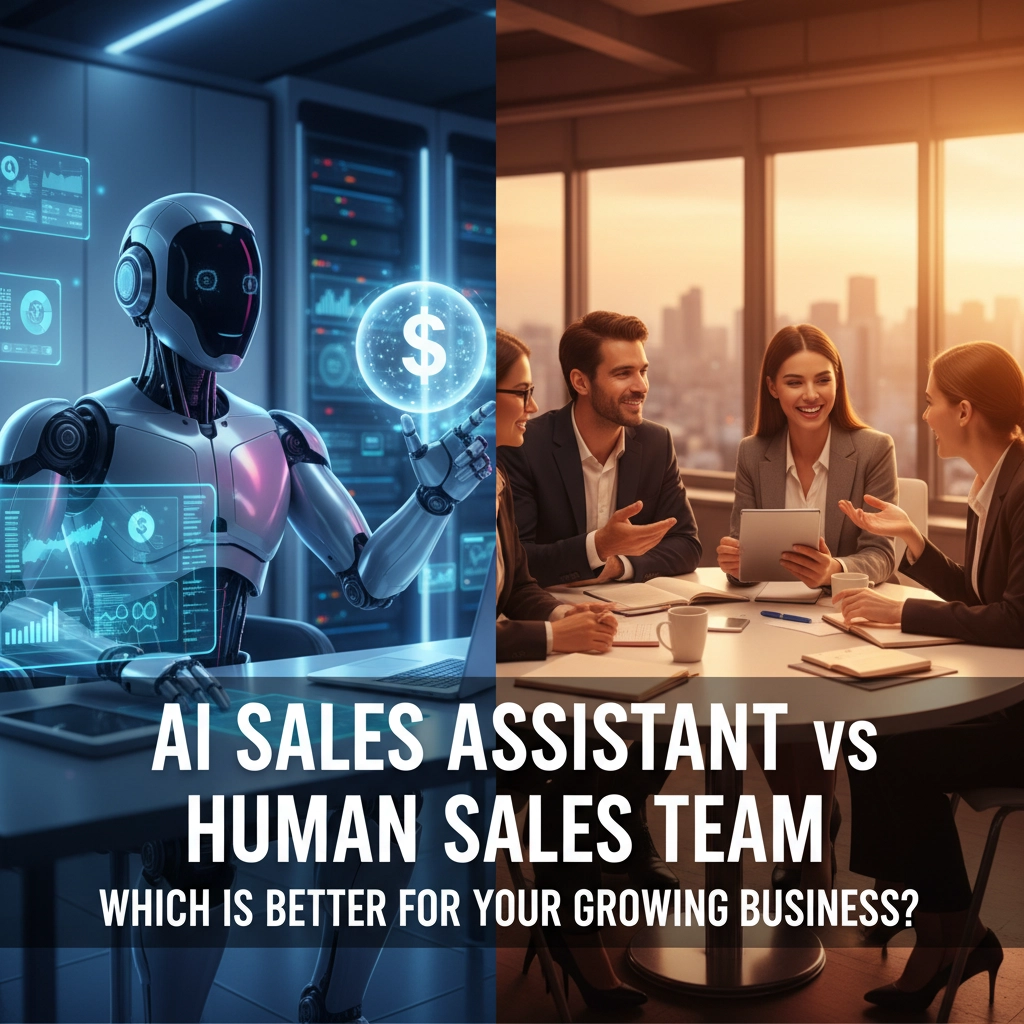
The sales landscape is experiencing its biggest transformation since the internet revolution. By 2025, over 85% of businesses are expected to integrate AI into their sales processes, yet the most successful companies aren't choosing between AI and human teams: they're strategically combining both. If you're trying to decide whether to invest in AI sales assistants or hire more human sales reps, the answer isn't as straightforward as you might think.
Recent data reveals that neither option is universally superior. The key lies in understanding when each approach excels and how to leverage their unique strengths for maximum business growth.
The AI Sales Assistant Advantage: Speed and Scale
AI sales assistants have fundamentally changed what's possible in terms of response time and customer engagement volume. These systems respond to customer inquiries in just 0.3 seconds, compared to the typical 4-24 hour response time from human teams. In today's instant-gratification economy, this speed advantage directly translates to higher conversion rates.

The scalability factor is equally impressive. A single AI assistant can simultaneously manage around 100 prospects, while human representatives typically handle just 5-10 at peak efficiency. This isn't just about quantity: it's about consistent quality at scale. AI systems never experience fatigue, maintain the same energy level at 3 AM as they do at 3 PM, and process over 50 customer data points instantly to deliver personalized responses.
From a productivity standpoint, companies implementing AI sales assistants report an average productivity increase of 67%, with AI qualifying leads 300% faster than their human counterparts. The financial impact is substantial: most businesses achieve ROI within 12 months, with efficiency gains compounding annually.
Cost Considerations for AI Implementation
The economics strongly favor AI for high-volume, routine interactions. While a human sales representative costs $65,000-$150,000 annually in salary alone, plus an additional $15,000-$30,000 in training costs and roughly 30% of salary in benefits, AI systems can be implemented and generating leads within weeks rather than months.
However, AI isn't without limitations. Despite processing capabilities that far exceed human capacity, AI systems struggle with complex relationship-building and nuanced deal closure scenarios. The technology excels at information delivery and initial qualification but falls short when emotional intelligence and strategic thinking become crucial.
Human Sales Teams: The Relationship Masters
Human sales representatives continue to dominate where relationships and complex decision-making matter most. Research from multiple industry studies shows that human sales reps are 2.5 times more likely to close a deal after an in-person or video meeting compared to AI-powered tools. This advantage stems from humans' ability to read social cues, adapt to unexpected situations, and build the emotional connections that drive purchasing decisions.

Customer retention rates tell a compelling story: human-led sales teams maintain approximately 75% customer retention compared to 60% for AI-only approaches. This difference reflects the deeper relationships and trust that human representatives can build over time. Qualitative feedback consistently shows that customers perceive human teams as better at understanding their unique needs and providing truly personalized solutions.
The emotional intelligence factor cannot be overstated. Humans excel in sensitive situations requiring empathy, complex negotiations demanding creative problem-solving, and scenarios where strategic thinking matters more than processing speed. When deals involve multiple stakeholders, complex terms, or significant financial commitments, human expertise remains irreplaceable.
The Human Team Limitations
The primary constraints for human sales teams revolve around scalability and availability. Humans can process 100-200 emails per hour versus AI's capability of 1,000 per hour. They require breaks, experience fatigue, and cannot maintain 24/7 availability that modern customers increasingly expect.
Training and onboarding present additional challenges. New human representatives typically require 3-6 months to reach full productivity, compared to AI systems that begin generating results immediately upon implementation. As businesses scale, the linear cost increases of hiring additional human representatives can become prohibitive.
Performance Comparison: The Numbers
| Metric | AI Sales Assistants | Human Sales Teams |
|---|---|---|
| Response Time | 0.3 seconds | 4-24 hours |
| Availability | 24/7 continuous | Business hours + scheduled |
| Concurrent Prospects | 100+ per system | 5-10 per representative |
| Lead Qualification Speed | 300% faster than humans | Baseline human speed |
| Complex Deal Closure | 60% retention rate | 2.5x better at closing, 75% retention |
| Annual Cost per Rep | Implementation + subscription | $65,000-$150,000 + $15,000-$30,000 training |
| Data Processing | 50+ points instantly | Manual research required |
| Customer Preference | Efficient but impersonal | 80% prefer human interaction for complex purchases |
The Hybrid Approach: Best of Both Worlds
The most successful sales organizations in 2025 aren't choosing sides: they're building hybrid systems that maximize the strengths of both AI and human teams. Companies using combined approaches report 15% higher conversion rates and 20% better deal closure rates compared to single-approach strategies.

One compelling case study from a mid-market SaaS company showed remarkable results after implementing a hybrid model: 25% increase in conversion rates, 30% reduction in sales cycle duration, and 20% increase in average deal size. These improvements came from strategically dividing responsibilities based on each team's core competencies.
In the optimal hybrid model, AI handles routine interactions, initial lead qualification, 24/7 customer support, data analysis and reporting, and administrative tasks like contract preparation. Meanwhile, humans focus on relationship-building with qualified prospects, complex deal negotiations, personal storytelling and brand building, reading emotional cues and adapting strategies, and managing high-value client relationships.
Strategic Recommendations by Business Type
High-Volume Transactional Sales (E-commerce, Retail)
For businesses processing hundreds or thousands of customer interactions daily, AI assistants should form the foundation of your sales strategy. These systems efficiently handle routine inquiries, provide instant product information, and qualify leads around the clock. Incorporate human escalation only for complex issues or situations requiring emotional support.
Complex Enterprise Sales (B2B Solutions, Professional Services)
Enterprise sales environments require human expertise for relationship-building and deal closure, but AI can dramatically enhance human effectiveness. Use AI for lead qualification, prospect research, meeting scheduling, and administrative workflow automation. This allows your best human talent to focus exclusively on high-value conversations and strategic relationship development.
Mid-Market Growth Companies
Growing businesses should start with AI to establish efficient lead qualification and maintain cost-effective 24/7 availability. As revenue increases, selectively hire human sales talent for key accounts and complex deals. This approach allows you to scale efficiently while building the hybrid infrastructure that will support long-term growth.
Service Industries Requiring High Trust (Financial, Healthcare, Legal)
Trust-based industries should lead with human expertise for relationship-building and compliance requirements, while deploying AI for information delivery, routine explanations, and administrative automation. The combination maintains the personal touch that clients expect while improving operational efficiency.
Future-Proofing Your Sales Strategy
The sales technology landscape continues evolving rapidly, but certain trends are clear. AI capabilities in natural language processing and customer behavior analysis will continue improving, making AI assistants more sophisticated in their interactions. However, human skills in emotional intelligence, creative problem-solving, and relationship building remain irreplaceable.
Smart businesses are investing in both technologies and training programs that enhance human-AI collaboration. The future belongs to sales teams where AI amplifies human capabilities rather than replacing them entirely.
Making the Right Choice for Your Business
At Virtual Nexgen Solutions, we've helped hundreds of businesses navigate this exact decision. Our AI-powered virtual assistant services are designed to complement your existing human talent, not replace it. Whether you're looking to implement your first AI sales assistant or optimize an existing hybrid approach, we provide customized solutions that align with your specific business needs and growth objectives.
The key isn't choosing between AI and human sales teams: it's finding the right balance for your unique situation. Our expert team can analyze your current sales process, identify optimization opportunities, and design a hybrid approach that maximizes both efficiency and relationship-building effectiveness.
Ready to explore how AI sales assistants can enhance your existing sales strategy? Let's discuss your specific needs and goals. Schedule a free 30-minute consultation with our team to discover the optimal AI-human balance for your growing business: https://calendly.com/virtualnexgen-info/30min
The future of sales isn't about replacement: it's about intelligent augmentation that helps your team achieve more than ever before.