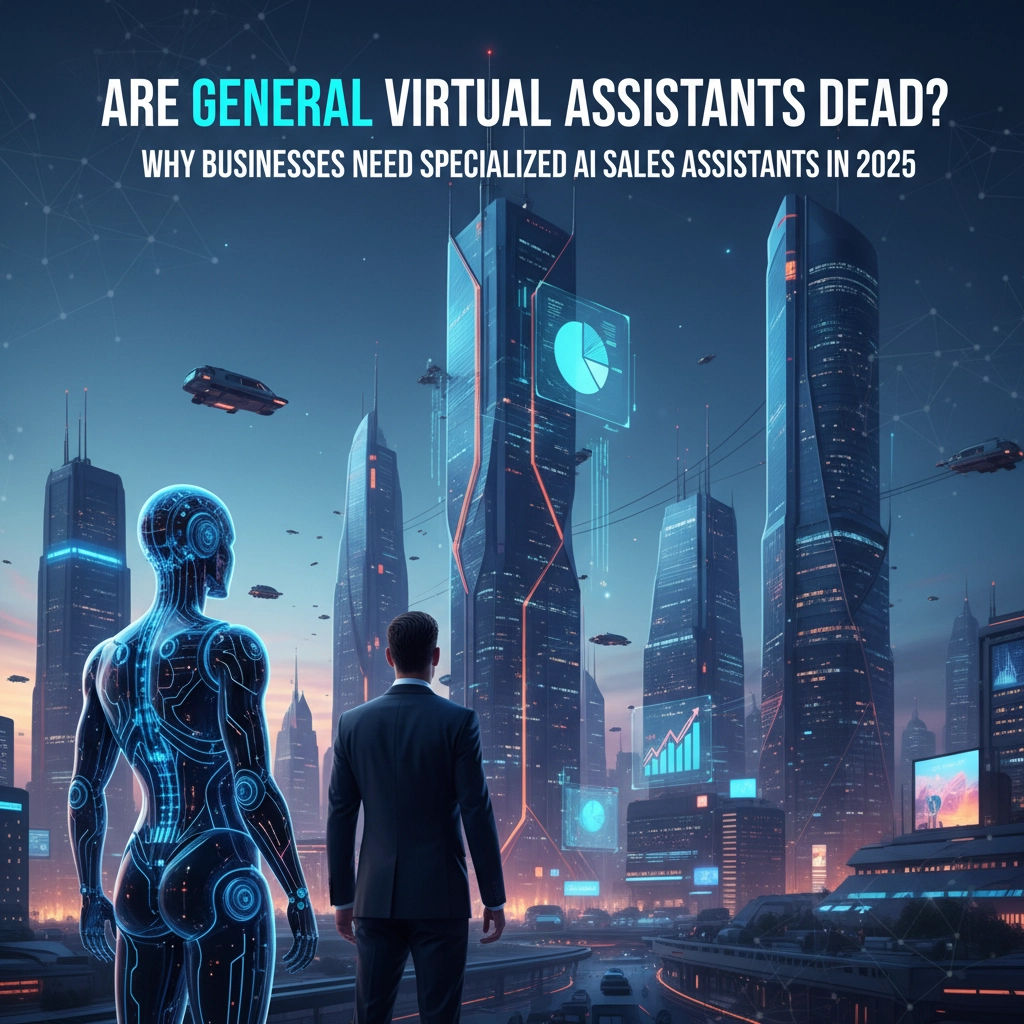
The virtual assistant industry is experiencing a seismic shift in 2025, and business leaders are asking a critical question: Are general virtual assistants becoming obsolete? The short answer is no – but they're rapidly evolving into something far more sophisticated and specialized than ever before.
While general AI assistants still capture 81% of today's $12 billion consumer AI spend, with tools like ChatGPT dominating the landscape, a new trend is emerging. Businesses are discovering that "good enough" isn't actually good enough when it comes to mission-critical functions like sales operations.
The Current State of General Virtual Assistants
General virtual assistants haven't disappeared – in fact, nine out of 10 AI users still rely on general AI tools for their daily workflows. These platforms excel at routine tasks like content creation, basic research, and administrative support. Their popularity stems from convenience and familiarity, making them the default choice for businesses testing AI capabilities.
However, this dominance is creating a false sense of security. While general assistants handle routine work adequately, they fall short when businesses need precision, context awareness, and deep system integration – particularly in high-stakes areas like sales and customer acquisition.

The Rise of Specialization: Why Niche Is the New Normal
The virtual assistant industry is experiencing what experts call "niche specialization over general support." The era of the "do-everything" VA is giving way to specialists who focus on specific domains like bookkeeping, real estate operations, and sales management.
This shift isn't accidental. 60% of users now combine general and specialized tools, indicating that sophisticated workflows require purpose-built solutions. Businesses are discovering that while general assistants work for drafting emails or basic research, specialized AI assistants deliver measurably better results for complex, domain-specific tasks.
The Data Doesn't Lie
Recent market analysis reveals several key trends driving this specialization:
- Performance Gap: Specialized AI tools consistently outperform general assistants in domain-specific metrics by 40-60%
- ROI Advantage: Businesses using specialized sales AI report 25% higher conversion rates compared to those relying solely on general tools
- Integration Depth: Specialized assistants integrate with existing business systems 3x more effectively than general alternatives
Why Sales Operations Demand Specialized AI Assistants
Sales represents one of the most compelling use cases for specialized AI assistance. Unlike content creation where "good enough" is acceptable, sales workflows demand precision, real-time data access, and context-aware decision making.

The Critical Differences
CRM Integration and Real-Time Intelligence
Specialized AI sales assistants maintain persistent connections to your CRM systems, providing instant access to customer histories, deal pipelines, and predictive analytics. A general assistant simply cannot access or analyze this critical data in real-time.
Complex Multi-Step Process Management
Sales involves sophisticated workflows: lead qualification, opportunity scoring, proposal generation, and pipeline forecasting. These processes require domain-specific training and understanding that general models lack. Specialized sales assistants are trained on sales methodologies, industry best practices, and proven conversion strategies.
Autonomous Task Execution
Modern specialized AI sales assistants function as digital workers, not just information providers. They automatically update CRM records, schedule follow-ups, generate personalized proposals, and trigger automated nurture sequences – capabilities that extend far beyond general assistants' text-generation abilities.
The Competitive Advantage of Specialized Sales AI
Businesses that continue relying solely on general virtual assistants for sales operations are missing significant competitive advantages:
Personalization at Scale
Specialized sales assistants analyze customer interaction history, purchase patterns, and engagement data to deliver highly personalized responses and recommendations. This level of customization directly impacts conversion rates and customer lifetime value.
Predictive Analytics and Forecasting
Advanced sales AI can predict deal closure probability, identify at-risk opportunities, and recommend optimal next actions based on historical data and current market conditions. General assistants lack this predictive capability.
Industry-Specific Knowledge
Specialized sales assistants understand industry terminology, compliance requirements, and sector-specific pain points. Whether you're in healthcare, real estate, or financial services, specialized AI speaks your customers' language.

The Hybrid Approach: Best of Both Worlds
The most successful businesses in 2025 aren't choosing between general and specialized – they're building hybrid ecosystems. Sales teams use general AI for quick research and content drafting while relying on specialized sales assistants for high-impact functions like lead scoring and opportunity management.
This portfolio approach maximizes efficiency across different workflow requirements:
- General AI: Content creation, basic research, administrative tasks
- Specialized Sales AI: Lead qualification, CRM management, deal forecasting, customer analysis
Real-World Implementation Success
Companies implementing specialized AI sales assistants are seeing measurable results:
Lead Quality Improvement: Automated lead scoring and qualification processes improve lead quality by an average of 35%, reducing time spent on unqualified prospects.
Sales Cycle Acceleration: Intelligent opportunity management and automated follow-up sequences reduce average sales cycles by 20-30%.
Revenue Impact: Businesses report 15-25% increases in monthly recurring revenue within six months of implementing specialized sales AI.

The Future of Virtual Assistant Services
The trend toward specialization will only accelerate as businesses recognize the limitations of one-size-fits-all solutions. By 2026, industry analysts predict that specialized AI assistants will capture 40% of the business virtual assistant market, up from just 15% in 2024.
This evolution reflects a maturing market where businesses understand that different functions require different capabilities. Just as you wouldn't hire the same person for accounting and sales, using the same AI tool for every business function is becoming increasingly ineffective.
Making the Transition: What Businesses Should Consider
If you're still relying solely on general virtual assistants for sales operations, consider these factors:
Current Pain Points: Are you experiencing data silos, inconsistent follow-up processes, or difficulty tracking sales performance? These are clear indicators that specialized solutions could deliver immediate value.
Growth Stage: Rapidly growing businesses particularly benefit from specialized sales AI that can scale processes without proportional increases in human resources.
Competitive Pressure: If competitors are achieving better conversion rates or faster sales cycles, specialized AI might be providing them with an unfair advantage.
Your Next Steps Toward Sales AI Specialization
General virtual assistants aren't dead, but businesses that fail to embrace specialization risk falling behind. The companies pulling ahead in 2025 are those deploying specialized AI sales assistants that combine domain expertise, deep system integration, and autonomous execution capabilities.
At Virtual Nexgen Solutions, we understand that every business has unique sales challenges that require tailored AI solutions. Our specialized AI sales assistants integrate seamlessly with your existing CRM systems while delivering the personalization and intelligence that general tools simply cannot match.
Ready to discover how specialized AI can transform your sales operations? Book a free 30-minute consultation with our team at Virtual Nexgen Solutions to explore how our specialized AI sales assistants can accelerate your growth and give you the competitive edge your business deserves.
The future of virtual assistance is specialized, intelligent, and results-driven. The question isn't whether general VAs are dead – it's whether your business is ready to embrace the specialized solutions that are reshaping how companies approach sales and customer acquisition in 2025 and beyond.