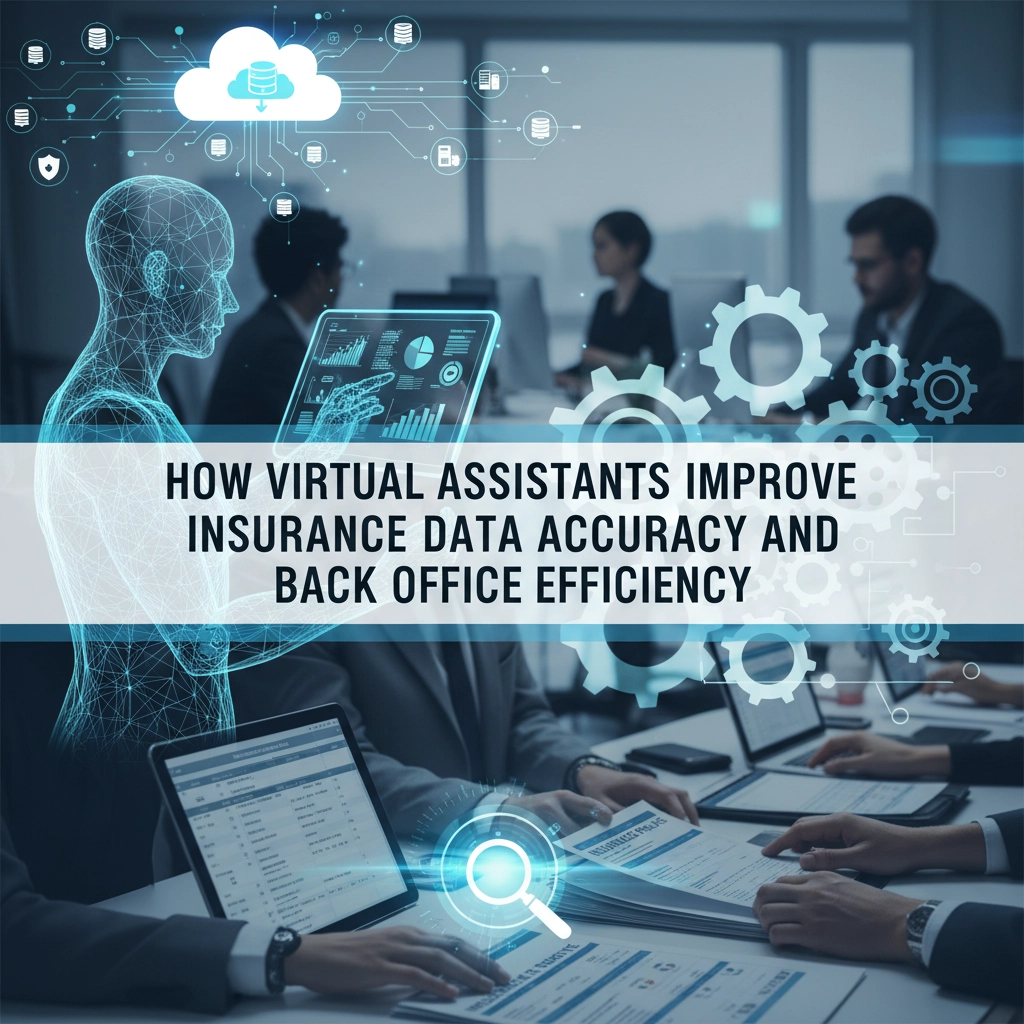
The insurance industry processes millions of data points daily, from policy applications to claims submissions. Yet manual data entry errors cost insurers billions annually while creating frustrated customers and compliance headaches. Virtual assistants and AI automation are revolutionizing how insurance companies handle back-office operations, delivering unprecedented accuracy improvements and operational efficiency gains.
The Current Data Accuracy Challenge in Insurance
Insurance companies struggle with data accuracy across multiple touchpoints. Manual data entry from paper forms, phone conversations, and digital submissions creates a 2-5% error rate that compounds throughout the policy lifecycle. These errors lead to claim delays, regulatory compliance issues, and customer dissatisfaction.
Traditional back-office processes involve multiple human handoffs, increasing the probability of transcription errors, missed fields, and inconsistent formatting. When a single policy application moves through underwriting, actuarial review, and final approval, each manual touch point introduces potential inaccuracies that can impact everything from pricing to claim settlements.

How Virtual Assistants Transform Data Accuracy
Automated Data Validation and Cross-Referencing
Virtual assistants excel at real-time data validation by comparing incoming information against multiple databases simultaneously. When processing a new policy application, AI systems can instantly verify addresses through postal databases, cross-check Social Security numbers with official records, and validate phone numbers and email addresses.
This automated validation catches errors at the point of entry rather than discovering them weeks later during underwriting or claims processing. Virtual assistants can flag inconsistencies like mismatched birth dates, invalid ZIP codes, or suspicious contact information, prompting immediate correction rather than allowing bad data to propagate through the system.
Intelligent Document Processing
Modern virtual assistants use Optical Character Recognition (OCR) combined with Natural Language Processing (NLP) to extract data from various document formats with 96-98% accuracy. Whether processing handwritten claim forms, medical records, or digital policy applications, AI systems can interpret context and extract relevant information while identifying potential discrepancies.
This technology transforms unstructured data from emails, PDFs, and scanned documents into clean, structured database entries. Virtual assistants can even identify when documents contain conflicting information and flag them for human review rather than making assumptions.
Streamlining Claims Processing Efficiency
Real-Time Claims Validation
Virtual assistants can settle over 60% of routine claims in real-time with exceptional accuracy. By instantly accessing policy details, coverage limits, and claim history, AI systems can validate claim eligibility and calculate settlements without human intervention for straightforward cases.
For complex claims requiring human oversight, virtual assistants prepare comprehensive case summaries, highlight potential issues, and suggest next steps. This preparation reduces research time from 3-5 minutes to just 30 seconds per claim, allowing human adjusters to focus on investigation and customer service rather than administrative tasks.

Automated Fraud Detection
Virtual assistants continuously monitor claim patterns and flag suspicious activities using machine learning algorithms trained on historical fraud data. They can identify red flags like duplicate claims, inconsistent injury reports, or unusual billing patterns that might escape human notice during busy periods.
This proactive fraud detection operates 24/7, analyzing new claims against established patterns while maintaining detailed audit trails for regulatory compliance. Virtual assistants can escalate suspicious cases to fraud investigators while processing legitimate claims without delays.
Back Office Automation Benefits
Policy Administration and Renewals
Virtual assistants automate routine policy administration tasks including renewal processing, coverage updates, and premium calculations. They can review policy terms, calculate prorated refunds, process endorsements, and generate renewal notices with minimal human oversight.
For insurance agencies, this automation eliminates hours of manual administrative work while ensuring consistent application of company policies and regulatory requirements. Virtual assistants can even identify optimization opportunities, such as customers who might benefit from different coverage levels or discounts they haven't claimed.
Customer Communication Management
AI-powered virtual assistants can handle routine customer inquiries, appointment scheduling, and policy questions through multiple channels including phone, email, and chat. They access complete customer histories to provide personalized responses while escalating complex issues to human agents with full context.
This 24/7 availability improves customer satisfaction while reducing the workload on human customer service representatives. Virtual assistants can also proactively reach out to customers for missing documentation or policy updates, ensuring nothing falls through the cracks.

Implementation Strategies for Maximum Efficiency
Integration with Existing Systems
Successful virtual assistant implementation requires seamless integration with existing insurance management systems, CRM platforms, and regulatory compliance tools. Modern AI solutions can connect with legacy systems through APIs while maintaining data security and regulatory compliance.
Virtual Nexgen Solutions specializes in creating customized automation workflows that integrate with your current technology stack without requiring expensive system overhauls. Our team designs solutions that enhance existing processes rather than replacing them entirely.
Staff Training and Change Management
Implementing virtual assistants requires careful change management to help staff adapt to new workflows. Employees need training on supervising AI systems, handling escalated cases, and focusing on high-value activities that require human judgment.
The most successful implementations involve gradual rollouts that demonstrate clear benefits while addressing staff concerns about job security. Virtual assistants augment human capabilities rather than replacing them, allowing staff to focus on complex problem-solving and customer relationship building.
Measuring ROI and Performance Improvements
Key Performance Indicators
Insurance companies implementing virtual assistants typically see significant improvements in key metrics:
- Data accuracy rates increase from 95-97% to 99%+
- Claims processing time reduces by 60-80% for routine cases
- Customer satisfaction scores improve due to faster response times
- Cost per claim decreases by $50-200 through reduced manual handling
- Compliance audit scores improve through consistent process application
Long-term Strategic Benefits
Beyond immediate efficiency gains, virtual assistants provide strategic advantages including scalability during peak periods, consistent service quality regardless of staffing levels, and detailed analytics for process optimization. They also enable insurance companies to handle volume increases without proportional staff increases.

Future of Insurance Back Office Automation
The next generation of virtual assistants will incorporate predictive analytics to anticipate customer needs, identify potential policy lapses before they occur, and suggest proactive interventions. Machine learning capabilities will continue improving, allowing AI systems to handle increasingly complex scenarios with minimal human oversight.
Integration with IoT devices, telematics data, and external data sources will enable virtual assistants to provide more accurate risk assessments and personalized policy recommendations. This evolution will transform insurance from a reactive to a proactive industry focused on risk prevention rather than just claim settlement.
Getting Started with Virtual Assistant Implementation
Implementing virtual assistants for insurance data accuracy and back office efficiency requires careful planning and expert guidance. The process involves evaluating current workflows, identifying automation opportunities, selecting appropriate technology solutions, and managing the transition to ensure minimal disruption.
Virtual Nexgen Solutions has extensive experience helping insurance agencies and companies implement AI automation workflows that deliver measurable results. Our team understands the unique challenges of insurance operations and regulatory requirements, ensuring compliant implementations that exceed performance expectations.
Ready to transform your insurance back office operations? Schedule a consultation with Virtual Nexgen Solutions to discuss how virtual assistants can improve your data accuracy and operational efficiency. Our experts will analyze your current processes and design customized automation solutions that deliver immediate ROI while positioning your organization for future growth.
Visit virtualnexgen.com to learn more about our comprehensive AI and virtual assistant services designed specifically for the insurance industry.