The business landscape has fundamentally shifted. By 2026, 72% of companies are using AI tools like ChatGPT and automation platforms, but the real winners aren't just adopting technology: they're completely reimagining how work gets done. If your business is still treating AI as a "nice-to-have" rather than a strategic necessity, you're already falling behind.
The difference between businesses that thrive and those that struggle in 2026 isn't access to AI technology. It's knowing how to integrate AI seamlessly into workflows to automate everything from customer support to complex decision-making processes.
The Current State: Beyond Basic Automation
Most businesses started with simple AI tools: chatbots for customer service or basic email automation. But the leaders have moved far beyond that. 50% of top-performing companies have restructured their entire processes around AI capabilities, while 22% have created completely new business models enabled by automation.
Here's what separates the leaders from the laggards: 80% of their AI budget goes toward reshaping and innovating, not just deploying tools. They're not asking "How can we use AI?" They're asking "How can we redesign our business to be AI-native?"

The 5 Game-Changing AI Trends Reshaping Business in 2026
1. Agentic AI: Your New Digital Workforce
The biggest shift happening right now is the explosion of task-specific AI agents. Gartner predicts 40% of enterprise applications will use AI agents by 2026, up from less than 5% in 2025.
These aren't just automated scripts: they're digital teammates that make decisions, learn from outcomes, and handle complex workflows independently:
- Customer Support Agents that resolve 80% of inquiries without human intervention
- Sales Agents that qualify leads, book meetings, and nurture prospects through entire funnels
- Financial Agents that manage compliance, detect fraud, and execute transactions in real-time
2. Enterprise-Wide Generative AI Integration
Generative AI has evolved from content creation to core business operations. Companies now use AI for:
- Marketing campaign creation and optimization
- Legal document drafting and contract analysis
- Product design and development acceleration
- Code generation and software development
One SaaS company implementing AI-driven personalized onboarding saw activation rates jump 35% in just two quarters: that's the kind of measurable impact that drives real business growth.
3. Hyper-Automation: Reimagining Entire Workflows
The most successful companies aren't just automating individual tasks: they're reimagining entire workflows from the ground up. A logistics company achieved 22% faster delivery times and 15% fuel cost reduction by implementing comprehensive AI-driven automation across their entire supply chain.

4. Industry-Specific AI Solutions
Generic AI is dead. The future belongs to industry-specific solutions that understand your unique challenges:
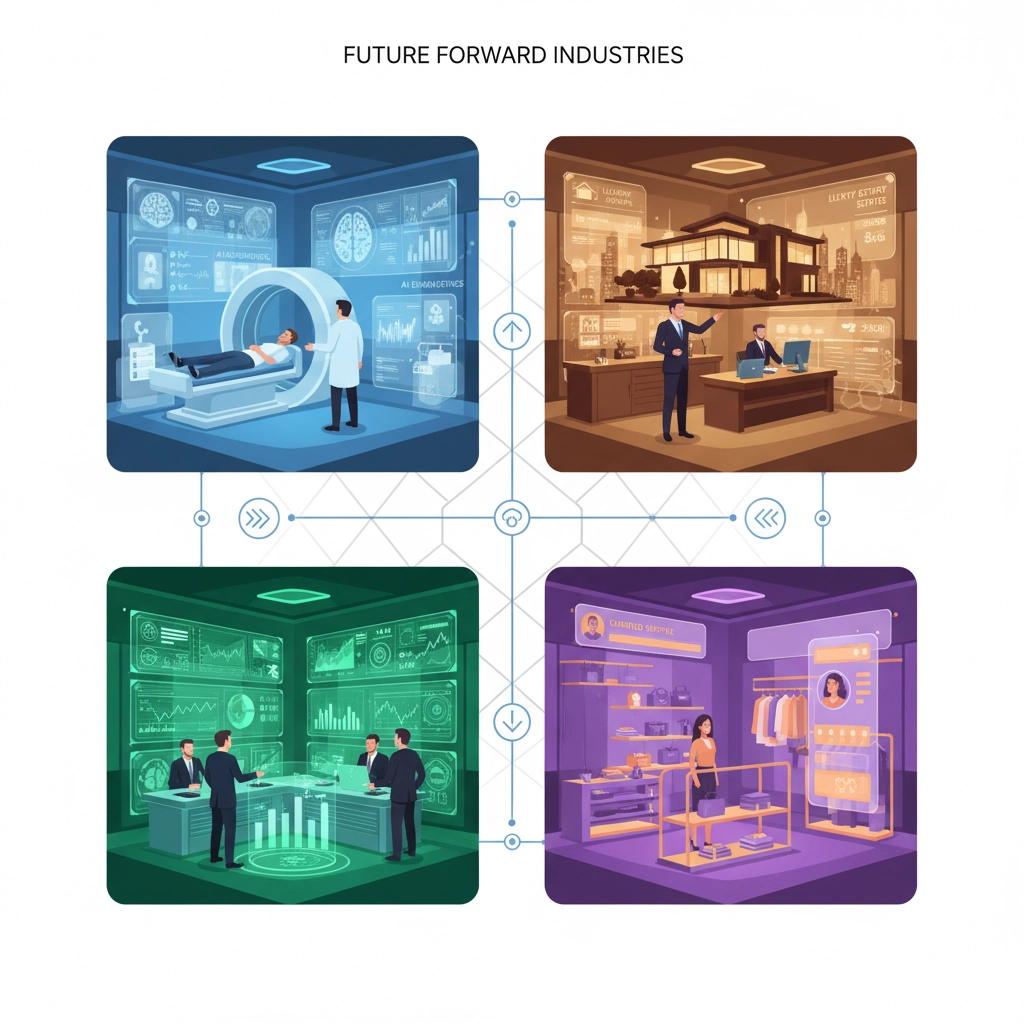
| Industry | AI Application | Business Impact |
|---|---|---|
| Healthcare | Predictive diagnostics | Earlier disease detection |
| Real Estate | Lead qualification & nurturing | 3x higher conversion rates |
| Finance | Real-time fraud detection | Millisecond threat identification |
| Retail | Hyper-personalized recommendations | 4x higher customer lifetime value |
5. Regional AI Ecosystems and Data Control
Businesses are increasingly choosing local AI providers for better data control, compliance, and customization. This trend creates opportunities for companies that understand local market needs and regulatory requirements.
Your Strategic Implementation Framework
Phase 1: Assessment and Quick Wins (Weeks 1-4)
Start by identifying your highest-impact, lowest-complexity automation opportunities:
- Email management and response automation
- Lead qualification and initial outreach
- Appointment scheduling and calendar management
- Basic customer support queries
- Data entry and administrative tasks
The key is choosing processes where AI can deliver immediate ROI while you build more sophisticated capabilities.
Phase 2: Workflow Integration (Months 2-3)
This is where most businesses fail: they try to force AI into existing processes instead of redesigning processes around AI capabilities. Successful integration requires:
Seamless System Integration: Your AI tools must connect with existing CRM, email, and business systems without manual data transfer.
Clear Escalation Paths: Define exactly when and how AI hands off to human team members for complex situations.
Continuous Learning Loops: Implement feedback mechanisms so your AI improves performance over time.

Phase 3: Advanced Automation (Months 4-6)
Once basic workflows are optimized, expand into more complex applications:
- Predictive Analytics: Spot trends and risks before they impact your business
- Multi-Step Decision Trees: Handle complex customer journeys and sales processes
- Cross-Functional Coordination: AI agents that coordinate between departments
- Strategic Analysis: AI-powered insights for business planning and optimization
Industry-Specific Implementation Strategies
Real Estate: From Lead to Close Automation
Real estate professionals implementing comprehensive AI automation report 3x industry-average conversion rates. The key is end-to-end process automation:
- Lead capture and initial qualification
- Automated property matching and recommendations
- Scheduling and follow-up coordination
- Market analysis and pricing optimization
- Transaction management and client communication
Marketing Agencies: Scale Without Proportional Hiring
Marketing agencies use AI to deliver enterprise-level results with lean teams:
- Content creation and optimization across multiple channels
- Campaign performance analysis and real-time adjustments
- Client reporting and insights generation
- Lead nurturing and conversion optimization
Professional Services: Expertise at Scale
Law firms, accounting practices, and consultancies leverage AI for:
- Document analysis and contract review
- Research and information synthesis
- Client communication and project management
- Billing and administrative automation
Measuring ROI: The Numbers That Matter
Successful AI implementation delivers measurable results across multiple dimensions:
Efficiency Gains: 40-60% reduction in time spent on routine tasks
Cost Reduction: 25-35% decrease in operational expenses
Revenue Growth: 15-25% increase through improved lead conversion and customer retention
Speed to Market: 50-70% faster response times and decision-making
The compounding effect is where the real value lies. One company saw customer lifetime value increase 4x after implementing AI-driven personalization: that level of improvement doesn't come from incremental changes.
Common Implementation Pitfalls to Avoid
Pitfall #1: Technology-First Thinking
Don't start with "What AI tools should we use?" Start with "What business outcomes do we want to achieve?"
Pitfall #2: Trying to Automate Everything at Once
Focus on one high-impact workflow at a time. Perfect that process before moving to the next.
Pitfall #3: Neglecting Change Management
Your team needs training and support to work effectively with AI systems. Budget time and resources for adoption.
Pitfall #4: Choosing Generic Solutions
Industry-specific AI solutions consistently outperform generic tools because they understand your unique challenges and opportunities.
The Virtual Nexgen Solutions Advantage
At Virtual Nexgen Solutions, we don't just implement AI tools: we redesign your business processes to be AI-native from the ground up. Our approach combines industry expertise with cutting-edge automation technology to deliver measurable business results.
Our specialized AI automation services include:
- Custom AI Agent Development: Task-specific agents for your unique workflows
- Marketing Automation: End-to-end campaign management and optimization
- Customer Support Automation: 24/7 intelligent customer service systems
- Sales Process Automation: From lead qualification to deal closing
- Administrative Automation: Bookkeeping, scheduling, and operational tasks
We've helped businesses achieve 3x conversion rate improvements, 35% operational cost reductions, and 4x customer lifetime value increases through strategic AI implementation.

Your Next Steps: From Planning to Implementation
The businesses winning with AI in 2026 started their transformation yesterday. Every day you wait is another day your competitors pull ahead.
Here's your action plan:
- Audit your current processes to identify automation opportunities
- Choose your first high-impact workflow for AI implementation
- Partner with AI automation experts who understand your industry
- Start with quick wins while building more sophisticated capabilities
- Measure everything and optimize based on real performance data
The question isn't whether your business will adopt AI automation: it's whether you'll be a leader or a follower in the transformation.
Ready to Automate Your Business with AI?
Don't let your competitors gain an insurmountable advantage while you're still planning. The AI automation experts at Virtual Nexgen Solutions are ready to help you implement game-changing automation that drives real business results.
Book your free AI automation strategy session today and discover exactly how AI can transform your business operations, reduce costs, and accelerate growth.
Schedule your consultation here and take the first step toward building your AI-powered competitive advantage.